Admin / February 20, 2026
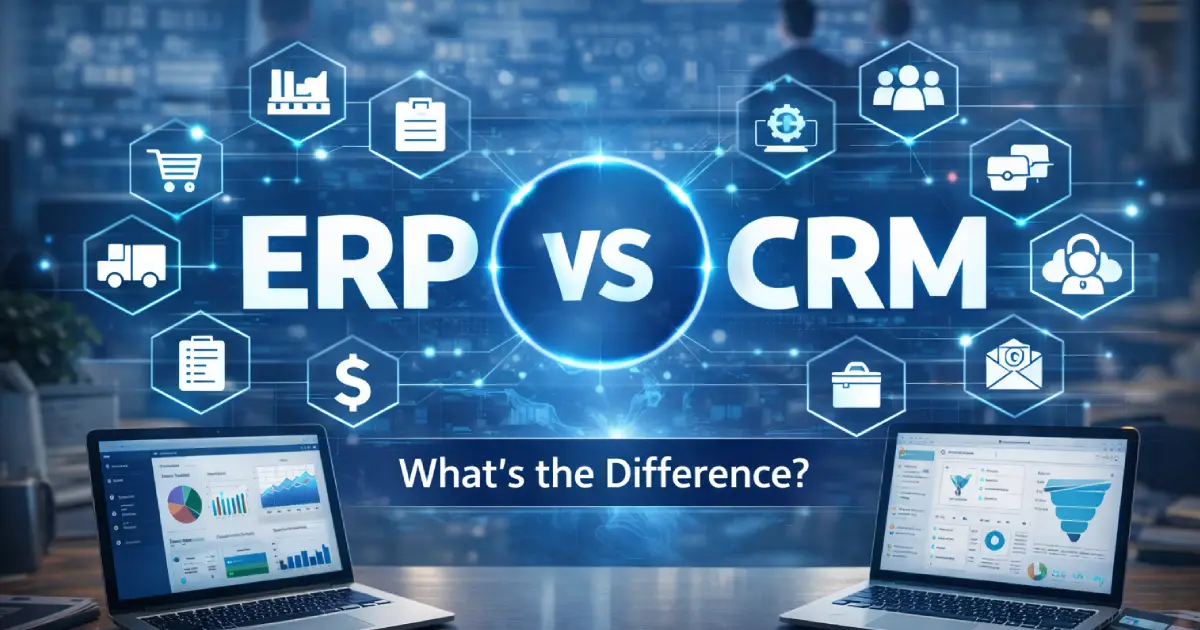
Businesses worldwide rely on software systems to manage operations, customers, and growth. Two of the most commonly discussed systems are ERP and CRM.
However, many business owners still ask:
ERP (Enterprise Resource Planning) manages internal business processes like finance, inventory, HR, and operations.
CRM (Customer Relationship Management) focuses on managing customer interactions, sales, and marketing activities.
Now let’s explore each in detail.
ERP stands for Enterprise Resource Planning.
If you’re wondering what is ERP software, it is a centralized system that integrates core business functions into one unified platform.
One of the biggest ERP system advantages is centralized data. All departments operate from a single database, improving accuracy and transparency.
ERP stands for Enterprise Resource Planning.
If you’re wondering what ERP software is, it is a centralized system that integrates core business functions into one unified platform.
One of the biggest ERP system advantages is centralized data. All departments operate from a single database, improving accuracy and transparency.
Cloud ERP refers to ERP software hosted on remote servers and accessed via the internet.
Understanding cloud ERP meaning is important because most modern ERP systems are cloud-based, making them accessible globally.
CRM stands for Customer Relationship Management.
CRM systems are designed to increase revenue by improving customer engagement and sales performance.
While ERP manages internal processes, CRM focuses on external customer relationships.
| Feature | ERP | CRM |
|---|---|---|
| Primary Focus | Internal operations | Customer relationships |
| Core Users | Operations, Finance, HR | Sales & Marketing teams |
| Main Goal | Efficiency & control | Revenue growth |
| Data Scope | Company-wide data | Customer-specific data |
| Implementation | Complex | Moderate |
| Scalability | High | High |
The ERP vs CRM debate isn’t about which is better — it’s about which fits your business needs.
The benefits of ERP include:
These ERP system advantages are particularly important for manufacturing, retail, and multi-location businesses.
CRM provides:
CRM directly impacts revenue growth, while ERP improves operational efficiency.
Many small businesses start with CRM because sales growth is the initial focus.
However, as operations grow, they often realize:
This is when ERP for small business becomes necessary.
Modern cloud ERP systems offer affordable subscription pricing, making ERP accessible even for startups.
Many growing businesses eventually implement both.
Both systems are available as cloud solutions.
Cloud-based systems allow businesses to scale internationally without heavy IT investment.
Both systems are available as cloud solutions.
Cloud-based systems allow businesses to scale internationally without heavy IT investment.
Here is a simple decision framework:
A strategic approach prevents costly mistakes.
Understanding ERP vs CRM is essential for making the right technology decision.
If you are asking what ERP software is, it is a powerful system that manages internal business processes. CRM, on the other hand, focuses on managing customer relationships.
The benefits of ERP include operational efficiency, automation, and scalability. CRM drives sales growth and customer retention.
For many businesses, especially growing companies, ERP for small business becomes necessary once operations expand beyond basic tools.
Ultimately, the right choice depends on your growth stage, operational complexity, and long-term strategy.
If your business is scaling globally, combining ERP and CRM may offer the most powerful solution.

304, Navle ICON, near Navale Bridge, Wadgaon Bk,Pune, Maharashtra 411041 (IN)
Copyright © 2025 Webwide It Solutions LLP.